How do you manage your photos? You do manage your photos, right? Whether you use Digikam, Lightroom, ACDSee or even Windows Explorer, you have a system?
Maybe you organise your photos by date. One folder per month, or one folder per photoshoot. Maybe you completely ignore folders, relying on your DAM to keep them in order.
Maybe you keep your RAWs and JPGs in the same folder with the same filenames. Maybe you develop the RAWs and then discard them, preferring to archive the JPGs. Maybe you have completely different folder structures for RAWs and JPGs.
All of these are perfectly valid choices. What they all have in common is that they’re all file management. They say nothing about your art.
Managing your photos might mean keeping every photo you’ve ever shot, carefully stored in annual folders and backed up to three different locations. It might mean keeping a stack of 35 near-identical shots of a nesting bird, with the best shot carefully moved to the top of the stack.
Curating is different. It’s more subjective, it’s more subtle, and it asks some very difficult questions. Is this photo worth keeping? Does this image rely on other images to tell its story? Sometimes even – is this photo worth keeping?
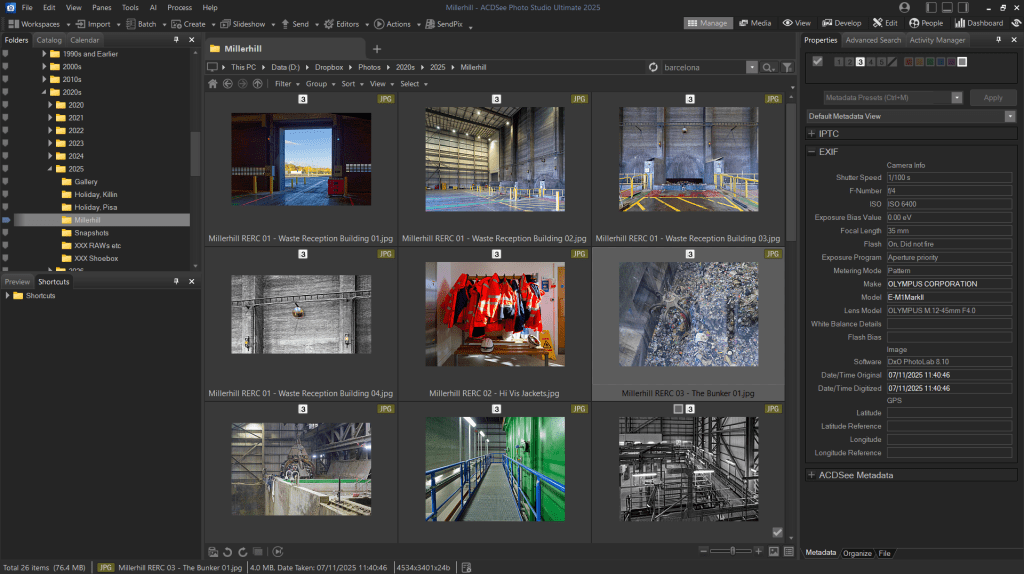
A screenshot from ACDSee showing a gallery of photos. Individually, these are just record shots. Viewed as a sequence, they tell a powerful story about saving household waste from landfill and using it to generate electricity. This is my final selection from a much larger photoshoot. Alternative photos, rejected photos, and RAWs are all stored in another folder.
For an analogy from analogue days, managing photos was about carefully filing the negatives and then stuffing the unwanted prints – still in their envelopes – into a sideboard drawer. Curating was about carefully selecting your favourite photos and placing them in an album.
In the digital era, managing photos is about ensuring that all your photographs are stored securely and that you know exactly where they are. Curating your photos is about understanding why you keep them and ensuring they tell the stories that are important to you.
So how do you do that? Social media is the obvious answer. Facebook galleries, Instagram reels. But the lifecycle of a Facebook gallery is measured in hours. Your friends might open the gallery when it’s first published, like a few photos, and then completely forget about them.
For a more permanent way of curating your images, photobooks are a great choice. Old-school photo albums work well too. (You do print your photos, right?) You can use anything, really, that turns your photos into a story.
For me, I use a digital photo frame. Or more accurately, an old Android tablet repurposed as a digital photo frame. I’ll return to that in a future post.
 My Camera Stories
Leave a comment