Chickens are funny, right? So when I saw a sign on the waterfront at Ullapool, advertising Elphin Chicken Day, I was immediately intrigued. So what is it? Well, according to the Facebook page, it’s a day of community fun. That means cakes, games, chickens. Who wouldn’t want to go?
Sadly in 2018 when this photo was taken, work commitments kept me away. But one day, surely, I’ll be in the area at the right time? Until then, this photo makes me smile every time I see it.
If you want to go to Elphin Chicken Day – or just want to visit the village – you’ll find it about 15 miles north of Ullapool, part of Scotland’s unmissable NC500 road trip. Be sure to slow down, spend some money in the local businesses, and enjoy the scenery. The date for 2026 hasn’t been announced yet, so maybe keep an eye on their Facebook page.
The is the view from the outdoor seating area at The Elphin Tearooms. Not a bad way to enjoy a cuppa!
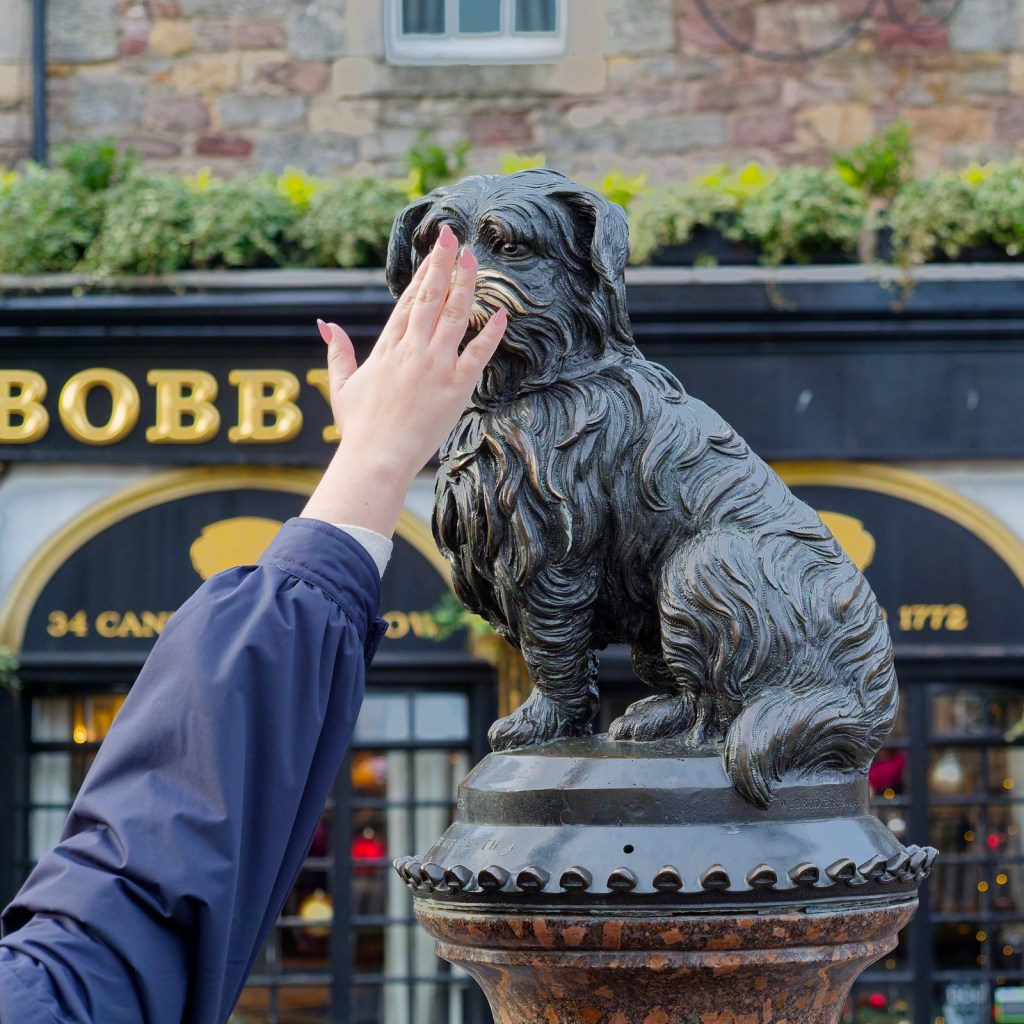
TL,DR – tourists rubbing his nose for luck. Because I hate it when websites have clickbaity titles and make you read through a whole load of irrelevancies before giving you the story.
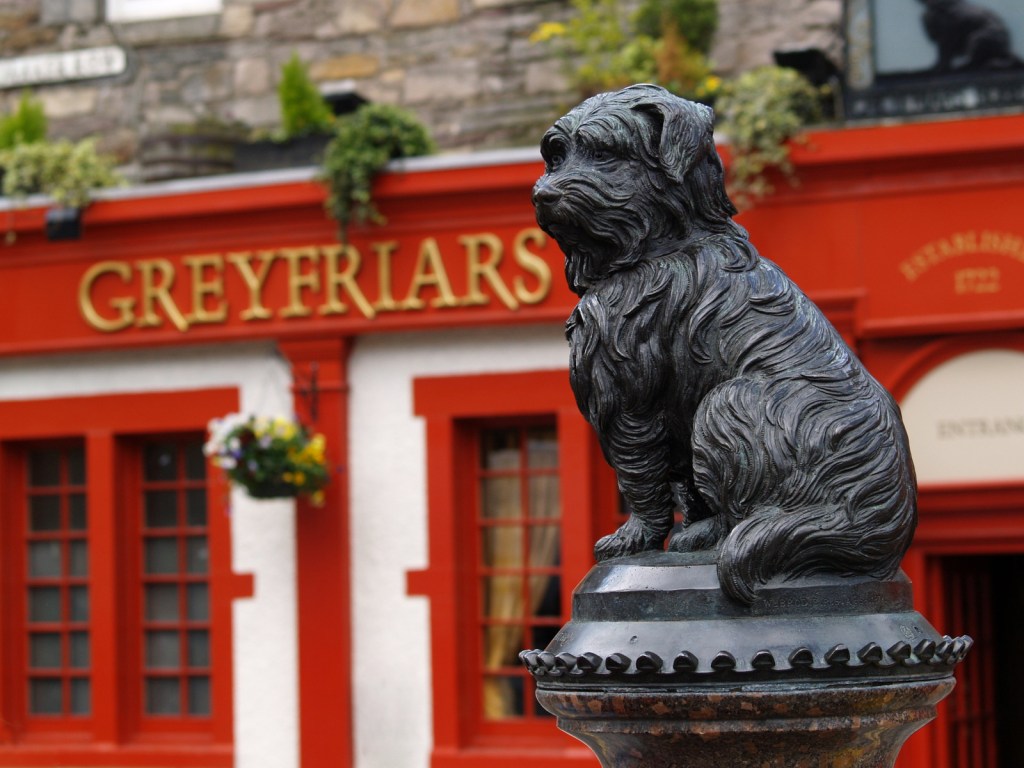
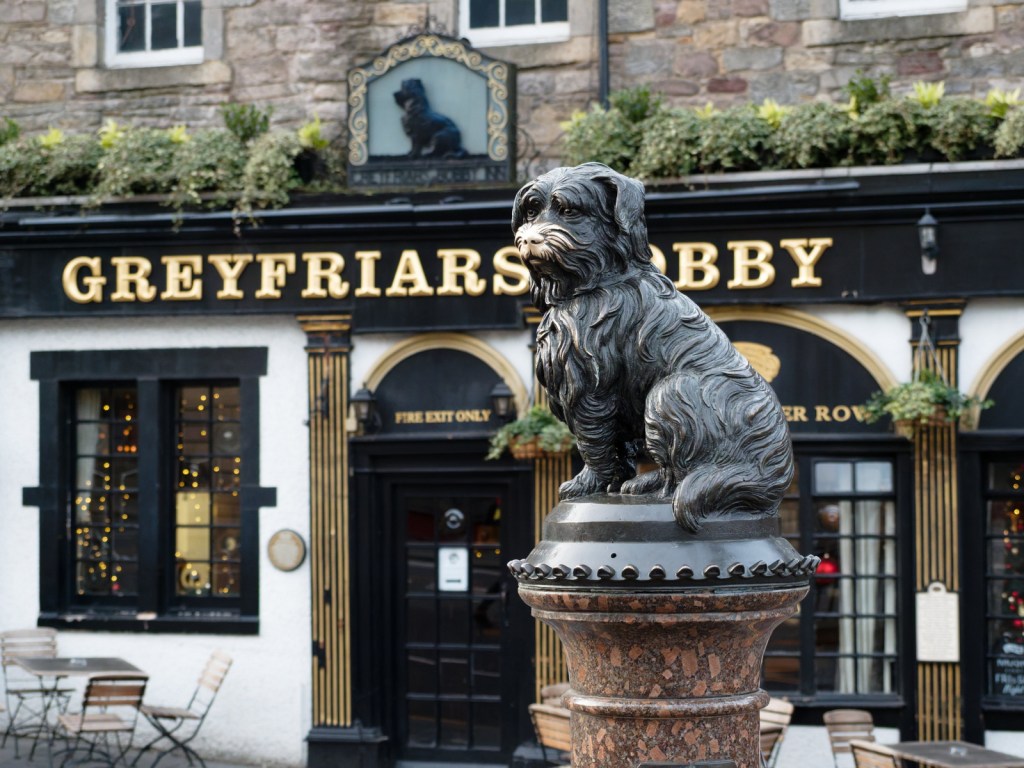
I’ve always been very happy with this photo of the Greyfriars Bobby statue, photographed in 2006. Look closely at Bobby’s nose, and compare it with this photo taken almost 20 years later in 2025. Even if we ignore the new paint colour of the pub behind, there’s something clearly amiss with the dog’s nose. Should it really be shiny like that? Well, clearly not.
When it was erected in 1873, the statue was the typical dark brown/greenish tinge that is common to most bronze statues. Over the decades, the patina has gradually darkened to the black seen in the first photo. And all was well until, sometime, around 2010, visitors started rubbing his nose for luck. And just to be clear, this isn’t a real Edinburgh tradition. It damages the statue and leaves it looking … well … odd.
From time to time, Edinburgh Council has attempted to restore the statue back to its natural black patina. Invariably, people carry on rubbing his nose and the shiny bronze nose returns.
Please don’t do this.
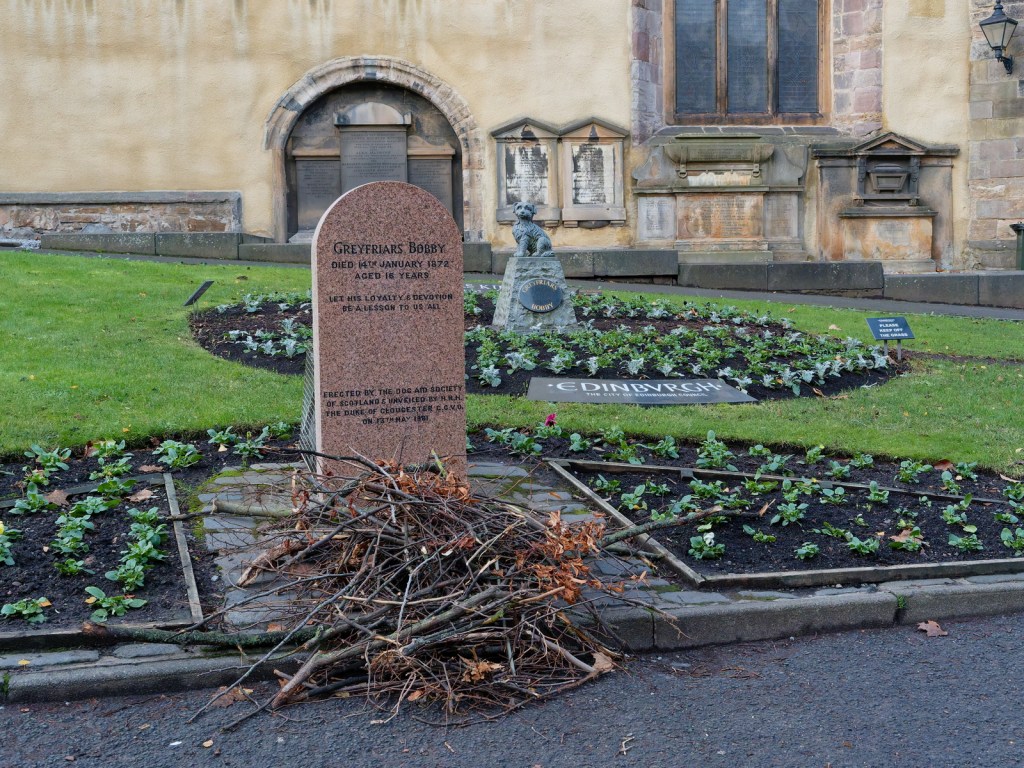
If you’re in the area, be sure to visit Greyfriars Kirkyard, accessed via an alleyway behind the sculpture. You’ll find Bobby’s grave there, marked not only by a modern gravestone, but also by a pile of sticks left there by visitors for Bobby to play with. That’s a much better tradition that I can get behind.
Read the story of Greyfriars Bobby here. It’s a fabulous slice of Edinburgh’s history.
Do you know where your photos from 20 years ago are?
The big social network of the day was MySpace. Theoretically it still exists, but a botched server migration in 2015 led to the loss of most user data – over 12 years of content – so if you were hoping to find your Christmas 2005 photos there, you’re out of luck.
Flickr was at the height of its popularity in 2005 but if you were on a free plan, it was strictly limited in the number of photos you could upload. Free storage limits have varied substantially over the years, and unless you’ve kept a close eye on account limits, it’s entirely possible that many of your photos have since been deleted to keep you within the storage quota.
Photobucket was another big player in 2005. And much like Flickr, storage limits have varied over the years. But unlike Flickr, Photobucket seems not to have deleted photos that breached free storage limits. Good news? Well, possibly – because Photobucket will give you a download link for your old photos if you reactivate your account and become a paid subscriber. But a trawl through old Reddit threads, while mostly positive, suggests there are some gaps in the archive.
FaceBook? Well, FaceBook in 2005 was much smaller than it is today. If you were a college or university student in the USA – possibly you had an account. If you were a normal punter in the UK, you had probably never heard of it.
So where does that leave us? The concept of unlimited cloud photo storage didn’t really exist in 2005. Dropbox camera uploads started in 2012. Google started offering the same service in 2015. So that’s another bust.
Most likely in 2005, your photos existed on CDs, memory cards, hard drives, maybe even floppy discs. Do you still have all your data from then? Do you have an unbroken chain of backups or transfers from one computer to the next, covering a period of two decades?
Thankfully I do. It probably helps that I studied information management at university so I learned the importance of building and maintaining archives very early. When I started using ACDSee PhotoStudio to manage my photos in 2016, I was able to migrate all of my digital photos into a single, easily managed database, backed up to multiple locations. A few years later I digitised the majority of my old film photos. They are now in the same database, and the result is a photographic archive dating back to my early childhood. Yes, I do know how lucky I am.
And where are my photos from 20 years ago? Well, that’s some of them there at the top of the page. Happy Christmas!
In 2005 I was still shooting film. Oh, I had a digital camera – the very capable Fujifilm Finepix E550 – but it was a compact, and I still loved the precision that came from the manual controls on my Canon EOS SLR.
It was a very fine balancing act. I was saving for a digital SLR, but they were still eye-wateringly out of reach for my limited budget. So my trusty Canon was what I took with me for serious photography.
Every time I shot film, of course, it cost money – for the film, for the processing – and where did that money come from? From my limited photography budget, of course, making the prospect of buying that digital SLR ever more remote.
But also in 2005, newspapers had pretty much completed the transition from film to digital, and that meant they had lots of old film camera equipment and accessories that they simply didn’t have any use for. My camera club was one of the beneficiaries. The East Lothian Courier, after a routine clear out, offered us a whole load of unexposed film and darkroom equipment.
Most club members had already migrated to digital, and politely declined. I said “yes please”, and was gifted a dozen rolls of Kodak TMAX P3200. Expired Kodak TMAX P3200. Expired 20 years ago, in fact.
I did a wee bit of searching online and discovered a thriving community of folk who enjoyed shooting expired film. It sounded like fun, and I already had the expired film for free. I was astonished to discover that people often paid a premium for it.
The results were mixed. Shooting street one day, I found a still-life of an old cane chair that I very much appreciated. And shooting at Barns Ness, I enjoyed the shapes and textures made by the limestone pavement. I was very happy with photos from both locations.
Other than that? Some shots of Kelso Abbey and Roxburgh Castle were disappointing. Landscapes of St Mary’s Loch were underexposed – a common problem with expired film. But that limestone pavement was fabulous. I’ve been back a few times shooting digital, but I’ve never recaptured the atmosphere of that long-expired free film.
I first encountered the ceramics of Lotte Glob in the far north of Scotland at Balnakiel Craft Village, near Durness. Even then, her work seemed to exist slightly apart from its surroundings. A mix of strange, playful shapes that felt organic despite their ceramic origins. She created mugs and plates too – we have one of her plates displayed on the sideboard in our kitchen sideboard – but it was the abstract pieces that stood out. Wee ceramic spheres that bobbed gently in the water. Strange organic forms that felt like they had descended from another planet.
Balnakiel was an abandoned army base, loosely transformed into artists’ studios. Every time we visited, it felt different. Opening hours drifted. Studios appeared and disappeared. The place positively encouraged a mindful wander, simply seeing what was there instead of seeking out anything in particular.
One studio kept drawing us back. Lotte Glob’s Far North gallery was one of the few that had reliable opening hours, and we made a point of visiting every time we were in the area. The work was beyond what we could reasonably afford, but we eventually chose the small side plate which is still proudly displayed in our kitchen.
In time, the Far North Gallery closed. Lotte moved to Laid, near Loch Erribol on Scotland’s far north coast and we stopped visiting the studio.
Loch Erribol has an unjustified reputation as Loch ‘Orrible – a legacy of the war, over 70 years ago. It’s an unfair reputation, for sure, but we remembered a disappointing holiday at nearby Bettyhill, many years earlier when the rain didn’t stop for a week. It was enough to stop us returning.
Until one day we searched out Lotte Glob’s website. The Contact Us page invited people to visit by appointment. We hesitated. We were conscious that we were unlikely to buy anything, and surely this was a working artist’s studio? But Lotte’s invitation seemed genuine so we filled out the contact form, and Lotte’s warm reply came very quickly.
Lotte has always placed her work in the landscape but it was hard to imagine how it would look. Those strange, alien shapes. Would they really fit in with the heather and thin grasses of this soil-poor land?
Of course it worked perfectly. Ceramic forms were scattered across the croft. Half-hidden in shallow folds of ground. Standing exposed against the sky. In one quiet corner, children’s messages from the local primary school added to the sense of place. The ceramic forms felt both foreign and entirely at ease, as if they had emerged from the land rather than being imposed on it.
The light shifted constantly. Cloud and sun swept over the hills, delivering a challenging light. My small Olympus camera struggled with the dynamic range, but I reasoned that these were the weather conditions we had been given, and Lotte’s work encouraged us to stay in the moment.
Before we left, we visited the studio to look more closely at Lotte’s current work. When she came out to speak with us the conversation seemed unforced, although I’m sure that we said the same conventional things as every other visitor.
The sculpture croft is still there. I hope it’s there forever. It’s a very special place.
I’m not a fan of power zoom lenses. It’s one of the reasons why I prefer SLR or mirrorless cameras to compact cameras. But they do have their place. In their powered-off state they can be absolutely tiny, allowing a compact camera to be as small as a pack of cards while still having a huge zoom range.
And so when I finally abandoned compact cameras, I dug out my old, almost forgotten, Olympus M.Zuiko Digital 14-42/3.5-5.6 EZ. Mounted on an even older Olympus Pen E-P3, the combination was truly impressive. Not quite as small as a compact, but it still slipped easily into a jacket pocket, and the combination gave me many of the advantages of a serious enthusiasts’ camera without weighing me down like my EM1 Mark II.
Which was all well and good until the 14-42 EZ died. The lens is sadly notorious for this. I’m sure there are many people out there who have used a 14-42 EZ for many years with no problem at all, but within six months of me starting to use it again, my copy succumbed to the dreaded and familiar ribbon failure. First, it refused to autofocus. Then it refused to manual focus. Then it started zooming erratically in and out for no reason. And finally it … died. The aperture stuck firmly closed, and the lens was useless.
This was very sad for me. Much as I dislike power zooms, the 14-42 EZ had a big role to play in my camera bag. My other standard zoom – the Olympus M.Zuiko 12-45 f4.0 Pro – balances awkwardly on a small camera body and requires a satchel or camera bag instead of a jacket pocket. So the 14-42 was the lightweight choice – ideal when I didn’t want to be weighed down.
So where next? I’m disenchanted by the 14-42 EZ, and too cautious to buy another in case it suffers the same fate. I could use a prime lens like the Olympus M.Zuiko 17mm f1.8 that’s already in my camera bag, but that would mean a complete change in my shooting style.
Hmm. Maybe the Panasonic Lumix 12-32 might be a suitable replacement? I don’t have a budget for it, but surely I could part-exchange the Olympus 17mm f1.8? After all, I’ve only used it once this year. Decisions, eh?
Have you ever gone back to a photo you’d forgotten, and found yourself wondering … how did I forget that? Of course your digital shoebox (and maybe an actual, real, shoebox if you’ve been taking photos as long as me) is full of photos you’ve forgotten. Occasionally you’ll go back to it, browse through, and find yourself muttering “I’d forgotten all about that”. But actual, real, portfolio-worthy photos that had completely slipped your mind?
In 2018 I was exploring the possibilities of travelling as light as possible. My camera of choice was an Olympus PM1 – an impossibly small camera which combined point-and-shoot simplicity with the image quality you might expect from a full-size mirrorless body. Combined with the Olympus 9mm bodycap lens, you had a fearsomely good architectural setup which would fit easily in a jacket pocket.
And so, in September 2018 I found myself at Seton Collegiate Church in East Lothian. It’s an atmospheric place, steeped in mediaeval history and with alleged – but hotly disputed – links to the Knights Templar. It’s also, usually, very quiet. It’s well off the beaten track. Tourists – at least in those days – rarely ventured there.
But with beautiful, well-kept grounds, nestling in woodland with goldfinches, tree creepers, and nuthatches regularly visiting, for a long time it was my regular haunt whenever I had new camera equipment and wanted to take a few test shots.
All of which, I think, explains why I completely forgot this photo even existed: it was a test shot, designed to help familiarise myself with a new lens. From the day I shot it, I never saw it as a keeper.
But something must have gelled with me because I imported the RAW into Lightroom, which I was trialling at the time, and managed to produce this dramatic monochrome shot. Which I instantly forgot. Oh well. I’ve found it again now. I hope you like it as much as I do – at least now that I remember it!
It’s been a few months now since I started this site. I waited till I had ten posts before I pressed the Publish button, and I’ve added another twenty posts since then. Early days still, but I see some themes developing, and I’m starting to see the topics I want to explore.
Very early on, I decided this was a blog in which I would tell the stories of my photographs and I think, mostly, I’ve done that. Portfolio sites are – frankly – mostly pretty boring. They’re useful, of course, as a shop window for commercial photographers. And undoubtedly many portfolio sites are very attractive to look at. But there’s often very little reason to return to a portfolio site. If you really want to follow a photographer there are other ways to do it – via Instagram, Facebook, or even Flickr.
Storytelling, on the other hand, is endlessly fascinating. We all love a good story, and even a fairly bland photograph can be of interest once you know the story behind it.
I’ll blog from anywhere – but the kitchen table is where I’m most comfortable
So here we are. Six months in from that day when I sat down at my kitchen table to write my first blog post. My biggest challenge has been, frankly, technical. I didn’t expect this. In my working life I was a wiki administrator, so I was well used to navigating, updating, and generally managing a cloud-hosted content management system. Unfortunately WordPress, it turns out, is way more complex than Confluence ever was.
Last week, finally, I got the blog navigation to work out (mostly) how I wanted it. My next task is to get to grips with featured images. At the moment, the blog is a mix of posts that do and don’t have featured images and, bluntly, it’s a mess. Maybe it doesn’t matter much at the moment but hopefully, as the blog continues to grow, in around a year’s time there will be around 100 posts to explore. And the current mess with featured images simply isn’t scalable.
Oh well. The writing part is usually pretty straightforward. The photography isn’t a problem – it’s the whole reason why I’m here. But managing the blog. Hey, that’s difficult!
Watching household rubbish being turned into electricity isn’t your average day out, but when my camera group was offered the opportunity to visit the Millerhill Recycling and Energy Recovery Facility, we enthusiastically accepted the invitation. We all arrived on a fine Autumn day, carefully reverse parking under the watchful gaze of the CCTV, and entered the facility to discover the story of how the stuff we throw away avoids landfill and ends up powering 30,000 homes.
Our visit began with a warm welcome and a PowerPoint from the facility’s administration lead, before we set off to explore the plant itself. What followed was a fascinating glimpse into one of Edinburgh’s quiet success stories; a wee slice of urban life that hums away in the background, keeping the lights on while the rest of us put the bins out.
View from the waste reception building, where refuse lorries deposit household waste to be incinerated. Another view of the waste reception building, showing the bare grey of the industrial architecture. Outside the main control room, a row of coat hooks with the ubiquitous high vis jackets and safety helmets. A large metal claw gathers huge piles of rubbish to be dropped into the furnace. It’s hard to get a sense of scale, but the claw was probably abut the size of a Ford Transit. The facility was full of liminal spaces like this. As our guide told us – “if you see a lot of people, it means something’s gone wrong”. We didn’t see many people while we were there. Another liminal space – a door, on a gantry at the Millerhill RERCThe tour took us onto the roof to see a view of the surrounding countryside, slowly being encroached by massive housing developments. I was more interested in this minimal view of the huge chimney. The facility was a gift for fans of industrial still life photography A view into the furnace, where the household waste is burned at a temperature of 1,300 cThe ash pile – all that’s left after the rubbish has passed through the furnace
In 2019 I felt the need for a new challenge. A recent trip to Mull had introduced me to the white tailed eagle – a truly magnificent bird, about the size of a barn door – and I’d come away enthused by my experience. I’d always enjoyed casually watching birds at the local park, but without ever really taking it seriously. Putting those elements together, and being primarily a photographer during my limited leisure time, I bought a 75-300mm lens for my Olympus camera and set out to learn a new skill.
White tailed eagle, Mull. Not a bad result on such a grim day, considering the very basic equipment I was using.
Early outings were predictably basic. Goosander at my local park. Robins and coal tits at the botanic gardens. Redshanks at Aberlady nature reserve.
The turning point came, ironically, during lockdown. Normally when I see people standing by the side of the pavement with their clipboards, poised to ask me my views, I shake my head and walk vigorously past. But walking home from Musselburgh lagoons one day, after an enjoyable session photographing the birdlife, a person with a clipboard, standing incongruously by a footpath through the lagoons, piqued my interest and I stopped to speak with him.
He was doing a survey, as it turned out, about people’s use of the lagoons in their leisure time. Musselburgh lagoons, bizarrely, are not a nature reserve. There are scrapes there, well maintained by East Lothian Council for use by the birdlife. It’s a familiar spot for birdwatchers – I’ve seen many rarities there – and people treat it as a special place for wildlife. But it’s also well used by dog walkers and there are multiple leisure activities that take place there – a BMX track, a boating lake, and even a horse racing track. It is, in short, a multi-use location that adds hugely to the amenities of the area. But it was also, in 2020, in danger of going seriously downhill.
Cockenzie power station, a few miles down the road, was one of Britain’s last coal-fired power stations. It was also the reason why Musselburgh lagoons existed. The lagoons were built on reclaimed land, formed by decades of waste from the power station being dumped and gradually forming new land which was then taken over by nature.
Now though, with the closure of the power station, the land was being handed over to the council who needed to find a use for it. Hence the person with the clipboard asking questions about how I used the lagoons, whether it benefited my mental and physical health, and what I thought should happen there. As I answered the questions, I found myself reflecting on my motivations for being there, and I gradually realised something very important.
I love photography. To this day, it remains my principle pastime. But I realised that when I was in nature, photographing wildlife, the camera often got in the way. I found myself using the camera as though it was a pair of digital binoculars, enjoying the experience of watching bird behaviours more than the experience of photographing them.
I didn’t modify my behaviour immediately, but over the following months I found myself going out more often with my binoculars, and less often with my camera. I joined a birdwatching group to enjoy the social aspect of birdwatching. And I leaned into the mindfulness of just enjoying spending time in nature.
A couple of years later, East Lothian Council opened a new set of bird hides at the lagoons. Last time I was there, I enjoyed watching a marsh sandpiper among the much more familiar lapwings, oystercatchers, and curlews. I hope my survey answers helped, in some small way, to persuade the council that the money invested was well spent.