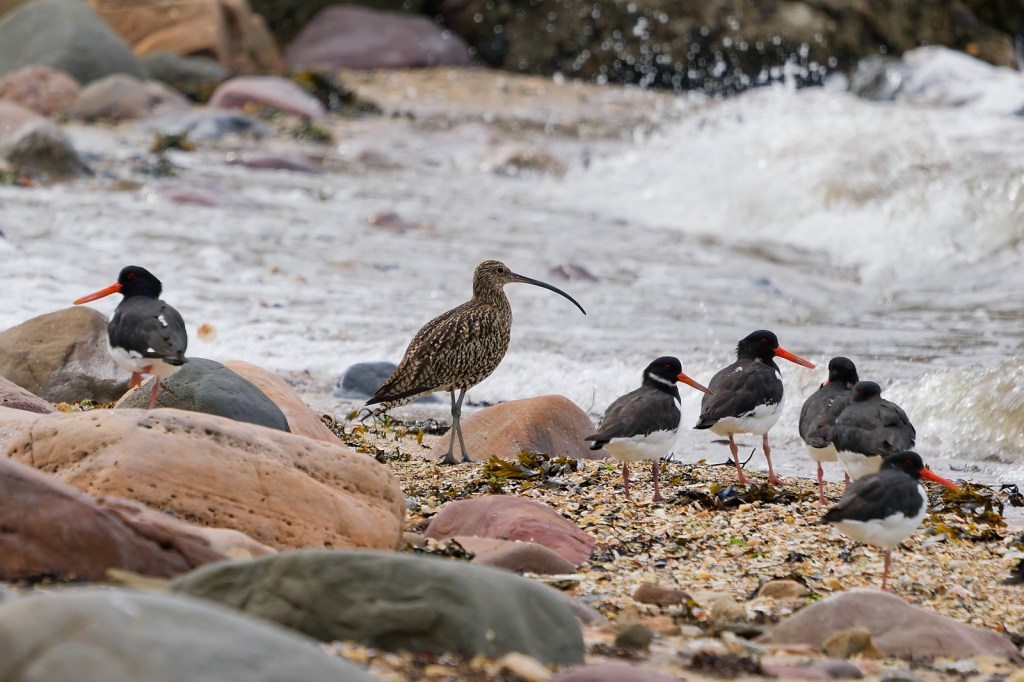
At Port Seton, near the caravan site where the Red Burn flows into the sea, a small beach lies hidden from view. Here the fresh water from the burn meets the salt water of the Firth of Forth, connecting the land and the sea. The iron ore which gave the burn its red colour has long since disappeared, but the name still commemorates East Lothian’s industrial history.
Every day, the tides reshape the shoreline, the sands shifting constantly. Coastal birds come and go, following the rhythms of the tide and the rhythms of the seasons.
The curlew stands apart, the muted plumage camouflaging it amongst the sand and the rocks. Around it, the oystercatchers command attention with their bold orange beaks.
The beach is easily overlooked. The outflow of the Red Burn separates this beach from Longniddry Bents to the east. Few people venture here, although the busy coastal road runs right past.
The birds remained only briefly. Just seconds after taking this photo, they were all gone – spooked by a sudden noise. The photo captures a fleeting moment, a group of birds in constant motion within a landscape that itself is continually changing. The scars of heavy industry give way, over generations, to the sounds of families enjoying their time on the shore.
The Curlew was my contribution to Portobello Art Walks 2026, in which a group of photographers was challenged to create an image on the theme Shift and Flow.
 My Camera Stories
Leave a comment