As I’m writing this, I have the windows wide open, enjoying the sounds and smells of a heavy rainfall during a break in a summer heatwave. There’s something special about British weather. Yes, we complain about it constantly. But those cloudy, overcast skies are a lot easier to live with than constant, relentless sunshine. And the rain! British rain can be glorious.
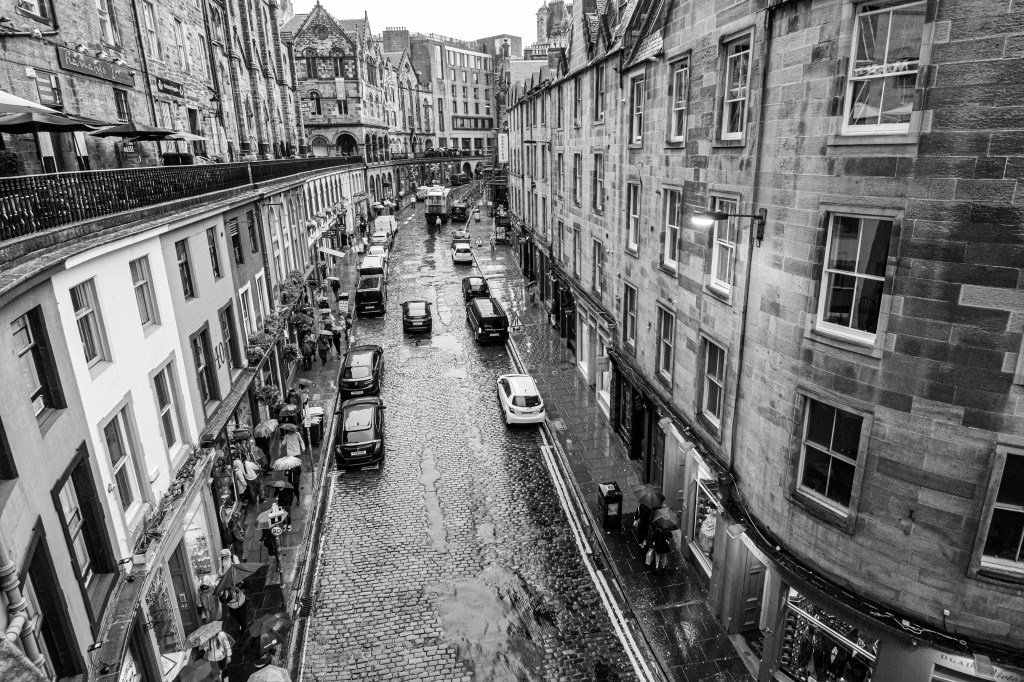
I had this photo in mind for weeks before I got the opportunity to shoot it. A wide-angle shot of Victoria Street,, the cobbles glistening in the rain. When the weather forecast was right, I charged my camera batteries and headed for Victoria Crescent, where a high angle gave me a chance to look down on the scene.
Victoria Street, 2019. Panasonic GX80, Olympus 9-18mm
Victoria Street is one of Edinburgh’s crown jewels. Search online, and you’ll find endless photos of people queuing at the Harry Potter shops, the colourful buildings towering over them. Photograph it in black and white, with the rain bringing out the textures of the cobbles and the sandstone tenements, and the effect is quite different.
Cars can’t drive down Victoria Street now as it’s been closed to traffic. A good thing, I think. It’s much nicer as a pedestrianised street. I wonder if that terrible tarmac patch has been repaired yet?
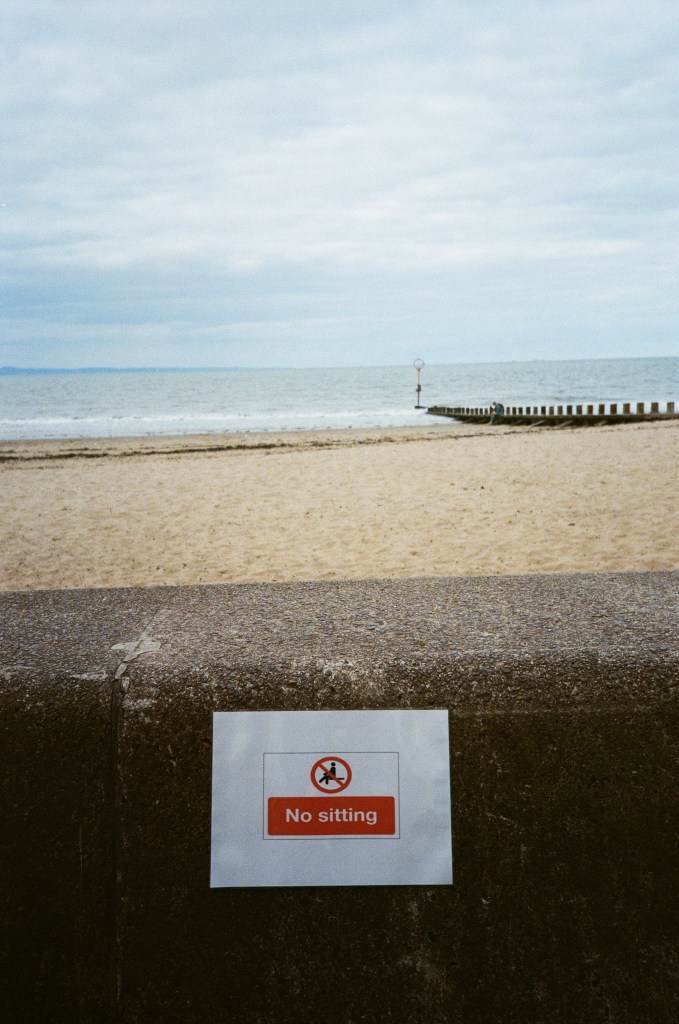
The covid lockdown of 2020 was the most extreme event of my adult life. Here in Scotland, there were times when we were restricted to our homes, allowed to go out only for “essential purposes” and – once a day – for exercise. The exercise rule was strictly enforced. Yes, you could walk the length of the prom, getting your 10,000 steps. But woe betide anyone who stopped for a seat because sitting isn’t exercise.
But how does a photographer react to such extreme events? If you answered “by documenting them”, then you have the same thought process as me. Once a day, I popped my Olympus XA3 in my pocket and wandered out for my daily exercise. The camera was chosen for its small size. Photography wasn’t essential exercise so I wanted to take a quick snapshot, without drawing attention to myself in the almost-deserted cityscape. And film instead of digital? Well, every frame you shoot costs money, and that forces you to make choices. Every day I went out for a walk, I took my film camera with me and shot a single frame. That roll of 36 exposures probably has the biggest number of “keepers” I’ve ever managed in my life.
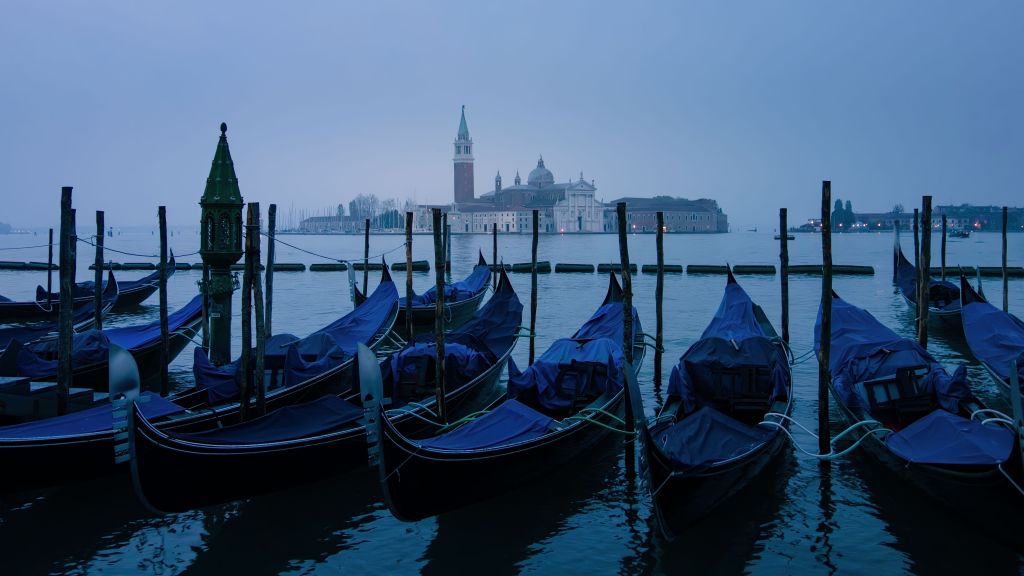
Gondolas bob in the water, moored by St Mark’s Square, Church of San Giorgio Maggiore in the background
How would you describe your photography in a single sentence? Maybe just a single word, even? A few years ago my friend Simon Wootton – letting his mouth get ahead of his thoughts – said that my photographs were “like snapshots, but the light is better”. I think he regretted it immediately, because he quickly added “I mean that as a compliment”.
Thank you Simon. Seriously. Because that sentence captures how I feel about my photography, and describes it far better that I ever could have.
Some people shoot landscapes, or wildlife, or sports, or news. And quite a lot of people shoot snapshots, so let’s celebrate that by taking the best snapshots we possibly can.
Which brings me on to this photograph of San Giorgio Maggiore from St Mark’s Square in Venice – the gondolas gently bobbing in the foreground. It’s a photo that’s been taken a million times, and I’m not naïve enough to think that I can add anything to it, But I was on holiday, I wanted to take the best photograph that I possibly could, and so I slipped out of the hotel pre-dawn to make my way to St Mark’s Square.
Yes, Venice really is at its best in the early morning, before the tourists all get up. I had the square to myself – well, me and a few street-cleaners in their high-vis jackets. I wandered over towards the Grand Canal and – leaning against a lamppost to stabilise myself in the half-dark – shot off half a dozen frames of San Giorgio Maggiore.
Later in the day, many thousands of tourists would stop beside the Doge’s Palace to take the same photo, but mine was already in the bag. Like a snapshot – but the light was better.
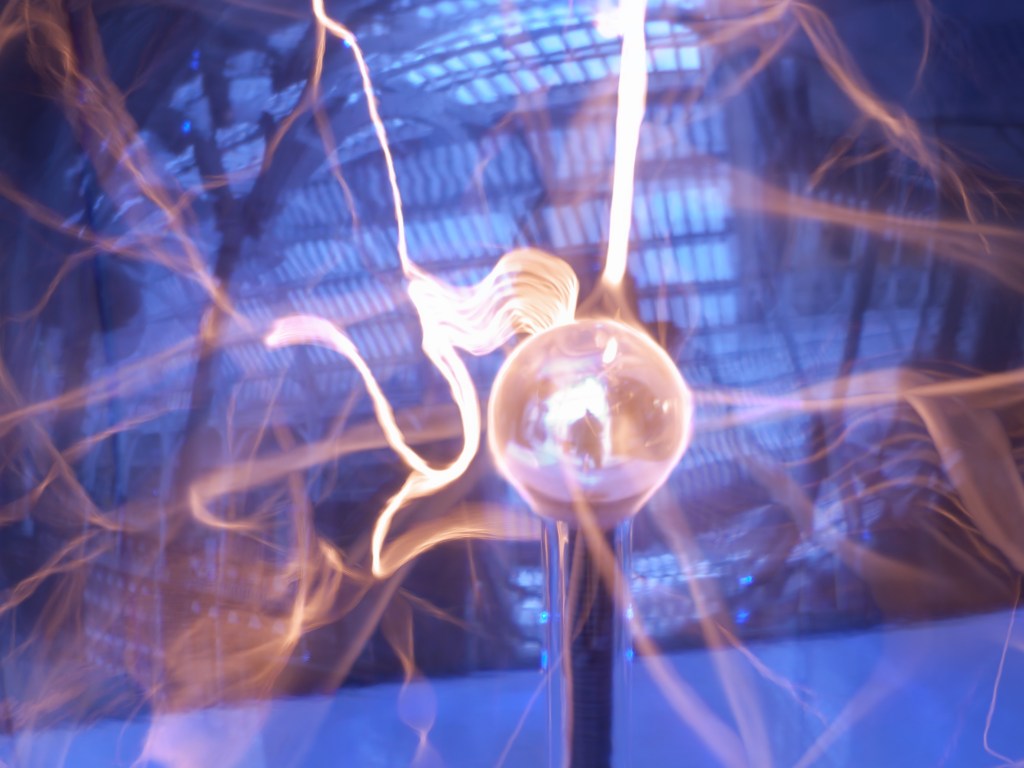
An abstract capture of a plasma ball showcasing vibrant lightning flashes and artistic light trails.
One of the joys of digital photography is trying new things and seeing what happens. Unlike film, it doesn’t cost anything to press the shutter and take a photo, so you can try crazy ideas just to see if they work. When you get home, review the photos onscreen and if they’re unsuccessful, simply reflect on what you could improve them next time. And press delete.
That’s how it was the day I took my infrared camera to the National Museum of Scotland. I’ve photographed this venue many times. Possibly even too many times. I’d never photographed it in infrared though, so on a bright sunshiny day I headed into the Grand Gallery to see what infrared would do to the familiar scene. The results were disappointing. The infrared colours were uninteresting, and if I converted the colours to black and white – well, they simply looked like conventional black and white photos. I got one successful image – a photo of a strong geometric shadow pattern contrasting with the curves of the circular radiators – but there was nothing unique about it. Nothing to suggest the other-worldliness that I was looking for.
Still, the National Museum is a place of many wonders, and as I wandered through the Science Gallery I spotted a plasma ball in a dark corner. Here was my chance to try something new. A silly idea? Possibly. My infrared camera – an ageing Olympus Pen E-P2 wasn’t noted for its low-light performance, and the kit lens only opened to f5.6 on full zoom. But hey! It wouldn’t cost anything, right?
My first half-dozen photos were grim failures, until I had the realisation that the lightning flash was dancing around the globe, making it impossible to capture the movement in a single exposure. Instead, holding the camera as still as possible, I shot five frames – each identical except for the lightning flash.
At home, I used Affinity Photo to open the photos as a stack, and then experimented with blend modes to get the right effect. That was the moment that I rendered this final photo. All in all, a successful morning.
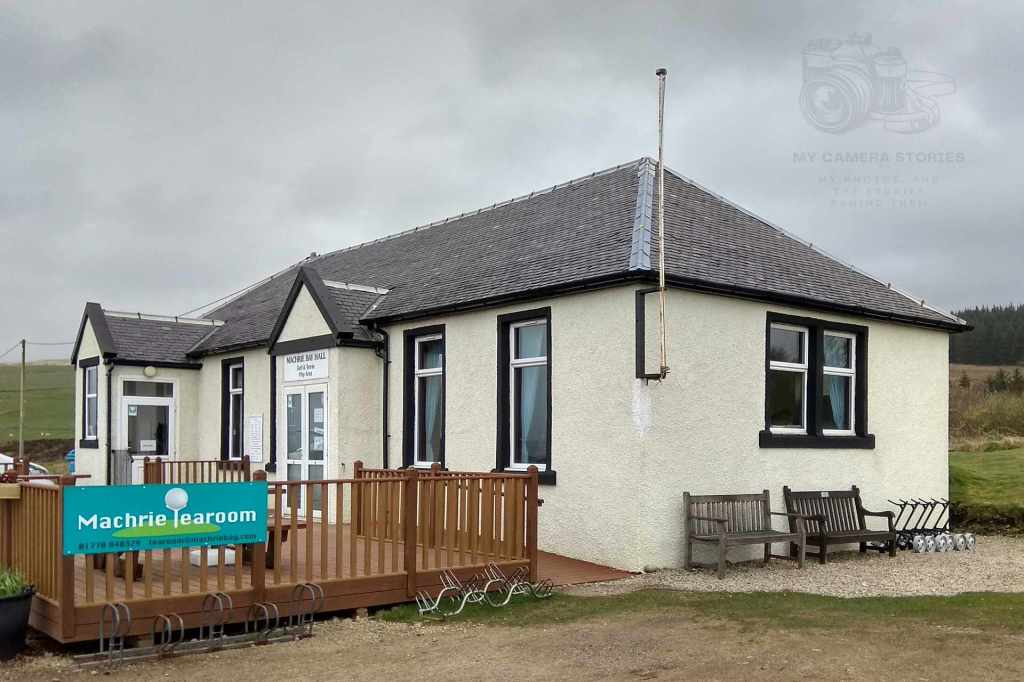
The Machrie Golf Club and Community Tuck Shop on the Isle of Arran, a popular refreshment stop for visitors.
Think of the photo that you’re most proud of. Maybe it’s a portrait of a friend or family member. Maybe it’s a beautiful landscape that took hours of hiking to get there, and then even more hours of editing to get it just perfect. Maybe it’s a piece of street photography where all the elements came together perfectly at the right moment. That’s the one you want to be your most viewed photo, right? The one that you want people to happen across when they’re online, and then stop and admire.
So what’s my most viewed photo? That would be a very ordinary street view photo of Machrie Bay Golf Club and Community Tuck Shop on the Isle of Arran, just off the west coast of Scotland. It’s just a snapshot. But crucially, it’s the right snapshot.
Over the years, I’ve had various online presences. My first website, around 2002, was moderately successful. The advertising – and remember this was before Google AdSense was available – paid enough to regularly buy new camera equipment. Then I migrated my photos to Flickr, which was rapidly becoming the place to share photos, and I was successful enough that my contributions regularly made it onto Flickr’s front page. But then the rise of social networks made Flickr feel old-fashioned, and I withdrew from sharing my photos online.
Fast forward to 2018. My wife and I were holidaying on Arran – one of the ruggedly beautiful islands off Scotland’s west coast. It’s a fabulous place to visit but, at least in 2018, you couldn’t expect coffee shops and Italian bistros on every corner. Driving a circuit round the island, my wife searched for a refreshment stop and found that the clubhouse at Machrie Golf Club offered good lunches to non-members. It wasn’t difficult to find, easily spotted from the main road, but navigating Google Street View on a phone can be pretty challenging, and I remember thinking that it would have been nice if Google Maps had had a photo showing exactly how it looked from the roadside.
Clearly lots of other folk had the same thought, because very quickly the number of times the photo had been viewed was over 100,000. Last time I checked, in mid 2025, the number was approaching 320,000. Not bad for a random snapshot.
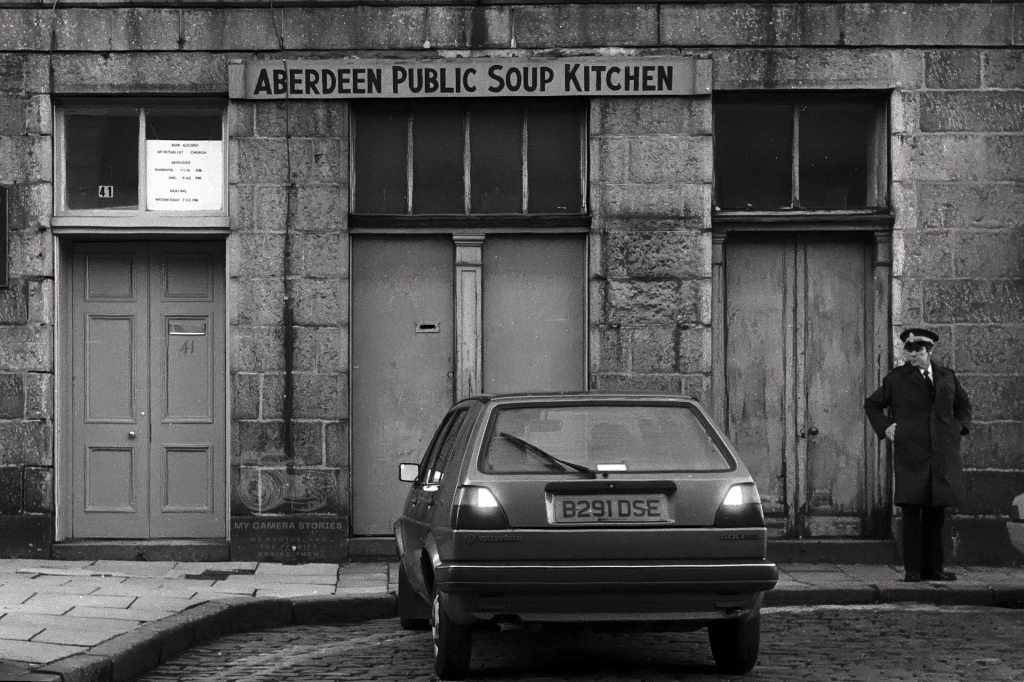
Historic view of the Aberdeen Public Soup Kitchen, featuring a parked Volkswagen Golf and a traffic warden.
In 1986, I didn’t really do street photography. My camera was a Zenit E – already a very heavy camera even before attaching the 58mm Helios lens. Somehow it never occurred to me to buy another lens so I was stuck with the 58mm focal length. The focal length was better suited for portrait work, and the split prism focussing made it easy to miss focus at the wide open apertures I used to avoid camera shake. But I did enjoy photographing buildings which were abandoned, neglected, or simply unloved, and this was what attracted me to the Aberdeen Public Soup Kitchen.
The nearby Bon Accord Centre had opened in 1984. It housed a great selection of shops but it also blocked the flow of traffic on George Street, and killed off many Aberdeen institutions such as the Rubber Shop. Sadly I have no photos of that, but I did explore the surrounding streets for photos of the old Northern Co-operative Society Arcade, and the Aberdeen Public Soup Kitchen.
I would have preferred to photograph the building straight-on, with no distractions in the way, but a permanently rotating selection of parked cars meant that that wasn’t possible. Instead, I positioned myself on the other side and waited for a scene to reveal itself. I’ve often wondered the story here. Has the traffic warden just issued a parking ticket? A warning? Or has the driver of the nearly-new Volkswagen Golf just beaten the system?
This is one of those photos that gets more valuable over time. The narrative aspect made it a good photo even when it was new, But 40 years later? Traffic wardens don’t look like that anymore. Cars don’t look like that anymore. And the Aberdeen Public Soup Kitchen is now a candle shop.
Clearly this is a photo which brings back memories for people, because from time to time I come across copies online. It pops up from time to time in the Aberdeen Memories Facebook page. There are multiple copies on Pinterest. And even a couple of websites which have reached out to me and asked for permission to use it.
I always enjoy seeing this photo in the wild. Of course if anyone used it commercially I’d be looking for a licensing fee. But until then, I’ll just enjoy it.
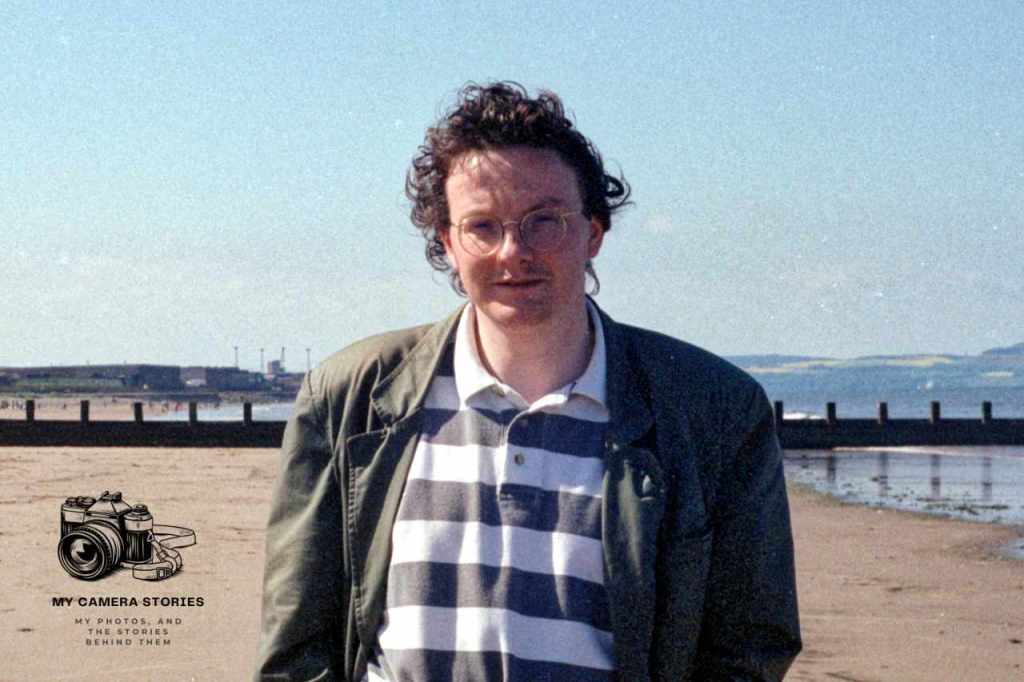
A personal portrait taken on Portobello Beach, capturing a pivotal moment in life.
It depends how you count it, of course. How do you define a serious hobbyist, and what differentiates them from a semi-professional? But using a few assumptions, I calculate that around 10 million photographers across the globe have some sort of website. Which leads to an obvious question: why one more?
Well, it’s easy to say that I take photos only for myself. And a lot of the time it’s true. But of the 6,000 or so photos I took last year there are a few – maybe a couple of dozen – which are good enough to share. So this is where I’m sharing them, and the stories behind them.
Have you ever been in a gallery, looking at an exhibit and wondering what you’re looking at? Chances are there’s some sort of interpretive text written on the exhibition label. Sometimes the interpretive texts are the only way to understand what you’re seeing. Sometimes you might spend more time reading the interpretive text than looking at the exhibit. That’s why the stories behind a painting or photo are important. By understanding the stories, we can better appreciate the image.
Of course not everyone will agree. Some photographers prefer their works to stand on their own, devoid of any explanation. And some photographers, like me, enjoy telling stories. Welcome to My Camera Stories – my photos, and the stories behind them.
About the photo
That’s me on Portobello Beach. The story here is very simple. Take a look at any old photo album. Spend time looking through it, and one person is always missing – the person who owned the camera. They would photograph the people around them, but they would rarely be the subject of a photograph. If they were, it was more likely to be a snapshot than a portrait.
Looking back at my own photos, I realise I’m an exception to this rule. I have often been surrounded by people who enjoy taking photos, and I feel very lucky to have so many good portraits of myself over the last half-century. This particular portrait was taken by my wife, shortly after we moved from London to Edinburgh in 1991. Looking back, I can’t believe we had the confidence to take such a leap into the unknown. New job, new city, new friends. In the end, it all worked out. After a couple of false starts, we found our feet. Secure jobs, friends around us, a home of own. But at this point, all that was still ahead of us, and I can see the worry behind my neutral expression.
Photos capture a moment. And this moment was one of the decisive moments of my life. I’m very lucky that my wife was there to capture it.