My Camera Stories

My photos and the stories behind them

  • King George V Park is one of Edinburgh’s hidden spaces. Maybe not an obvious place for casual visitors because it’s just a local park – a green space for local folk who don’t have their own gardens, and a place for children to play. And it’s also, bizarrely, the site of a disused railway tunnel that even Edinburgh residents often don’t know about.

    To get to King George V park, start at the Canonmills branch of Tesco. With the store behind you, cross the busy carpark access road, and find a fine path which follows the route of an old railway line. Turn left and pass through a short tunnel, attractively graffitied with colourful designs. On exiting the tunnel, go straight ahead through a brightly-painted gate, passing a children’s playground on your right, and come to a slightly dejected-looking basketball court.

    A basketball hoop in front of a disused railway tunnel with brick arch design, set against a black and white backdrop.
    Olympus OM-D EM10 Mark II, Olympus m.zuiko 25mm f1.8. Processed using DxO Photolab.

    The archway ahead of you forms the entrance to Scotland Street Tunnel. The tunnel has a strange history. Opened in 1847, it was closed just 21 years later.

    It hasn’t been entirely disused all that time. Shortly after the tunnel was closed, the Scottish Mushroom Company set up business, using the tunnel as a mushroom farm. That lasted until 1929, and the tunnel fell out of use again until being converted into an air raid shelter in the second world war.

    Since then, the tunnel has been completely inaccessible for the general public, although a YouTube video from 2023 gives a comprehensive look at the interior. It would be good if the tunnel could be reopened, as the 1km length could provide a safe and car-free walking/cycle route between Waverley and Canonmills. Until then, we can dream.
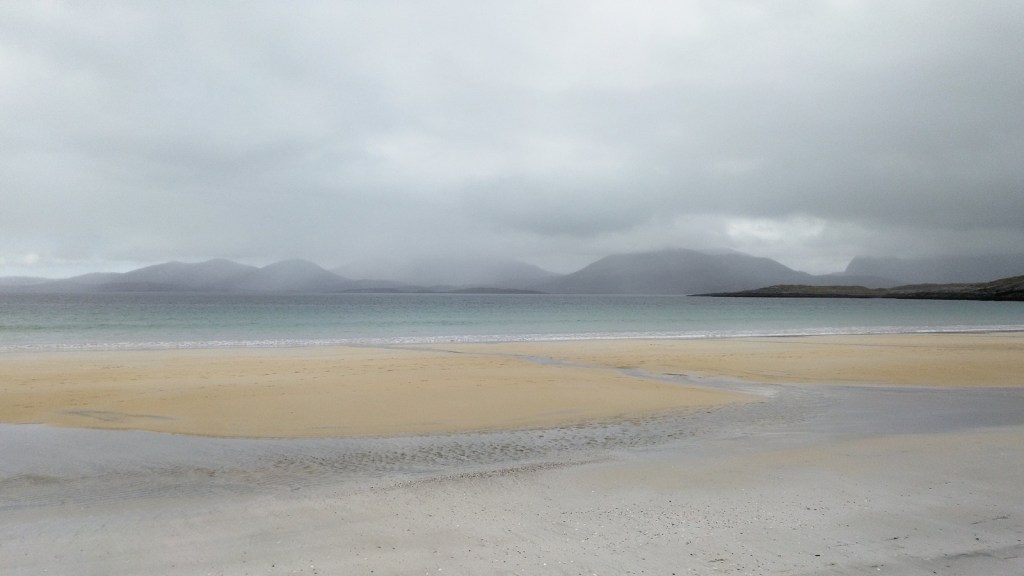
  • When you’re on holiday, you take the weather you’ve got. On the Isle of Harris, even in August, that frequently means overcast. So I approached Luskentyre beach – one of the UK’s most beautiful – with a sense of eagerness, looking forward to the exploration but not expecting to go home with any particularly great photos.

    A tranquil view of Luskentyre Beach on the Isle of Harris, featuring soft sand and a calm sea beneath an overcast sky, with distant misty mountains in the background.
    Luskentyre Beach, Harris, as captured using my Nokia 7.1

    Even though I had my camera with me, I didn’t even take it out of my satchel for this photo. It’s just a record shot, right? A memory from my holiday of a tranquil walk on the Isle of Harris. .

    Until today, watching a slideshow of the photos from that holiday, this photo stopped me in my tracks. Another hobby of mine is creating digital paintings from my photos, And looking at this one, I couldn’t tell if it was a photo or a painting. The muted colours, the sweep of clouds obscuring the details of the horizon. It all looked so … painterly. But no. When I checked the EXIF, I saw that this is exactly the image my phone captured. No editing, just a phone cam doing its thing, Nice one, Nokia.

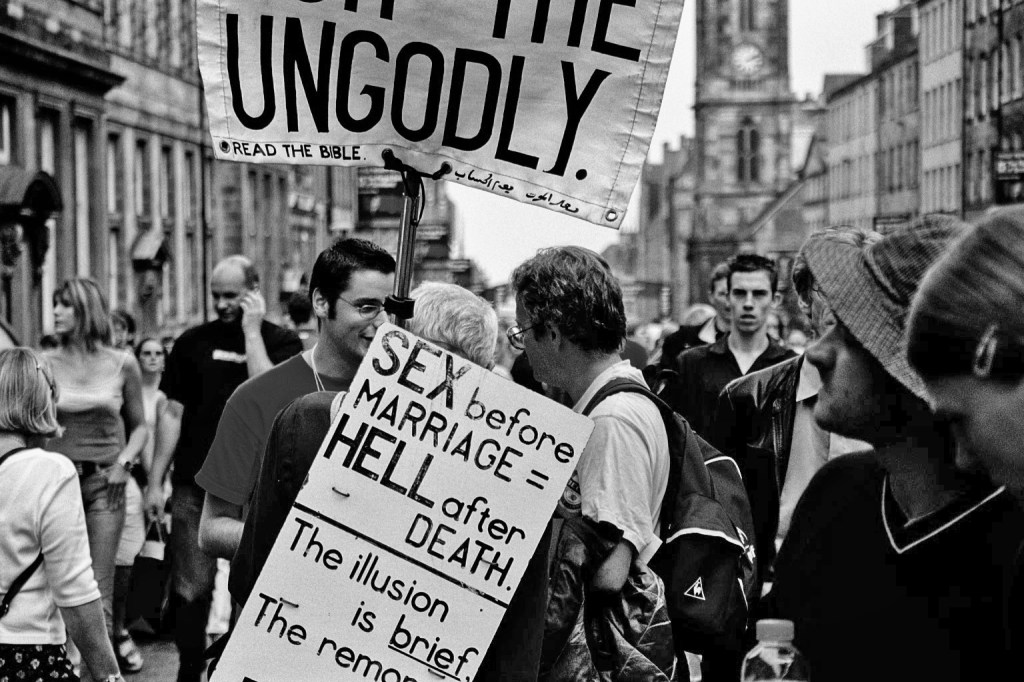
  • Every year during the Edinburgh Festival Fringe, preachers make their way to the city centre to spread their message of hell and damnation. This image from 2003 captures a fleeting moment of tension on the bustle of the Royal Mile.

    A preacher holds a placard with a warning about premarital sex on the Royal Mile during the Edinburgh Festival Fringe, engaging with a young man in front of a crowd. Surrounding them are various festival-goers, some glancing at the interaction while continuing with their activities.
    Edinburgh, 2003. The camera was probably a Canon EOS 3000 with kit lens. Film unknown.

    The image is anchored by the preacher’s placard bearing a stark message: SEX before marriage equals HELL after death. The preacher is speaking to a young man who appears to be wearing a makeshift sign, or maybe a lanyard, around his neck. Presumably he’s someone directly involved with the Fringe – most likely a performer. Someone who, to put it more bluntly, is unlikely to agree with the preacher’s message. All around them, life continues. People ignore the interaction, or glance quickly as they pass – hoping to see what’s happening without being drawn into the narrative.

    Adding to the claustrophobia, the scene is presented in harsh black and white, and tightly cropped. We can see enough of the surrounding streets to understand the context, and anyone who has visited Edinburgh during the Fringe will quickly quickly recognize the location. But this isn’t in any sense a portrait of Edinburgh. It’s a documentary image depicting the other voices striving to be heard amongst the hubbub of performance, celebration, and fun.

    Today, street preachers are still to be found on the Royal Mile. Still ignored by most passers-by. But sometimes their voices break through the noise.

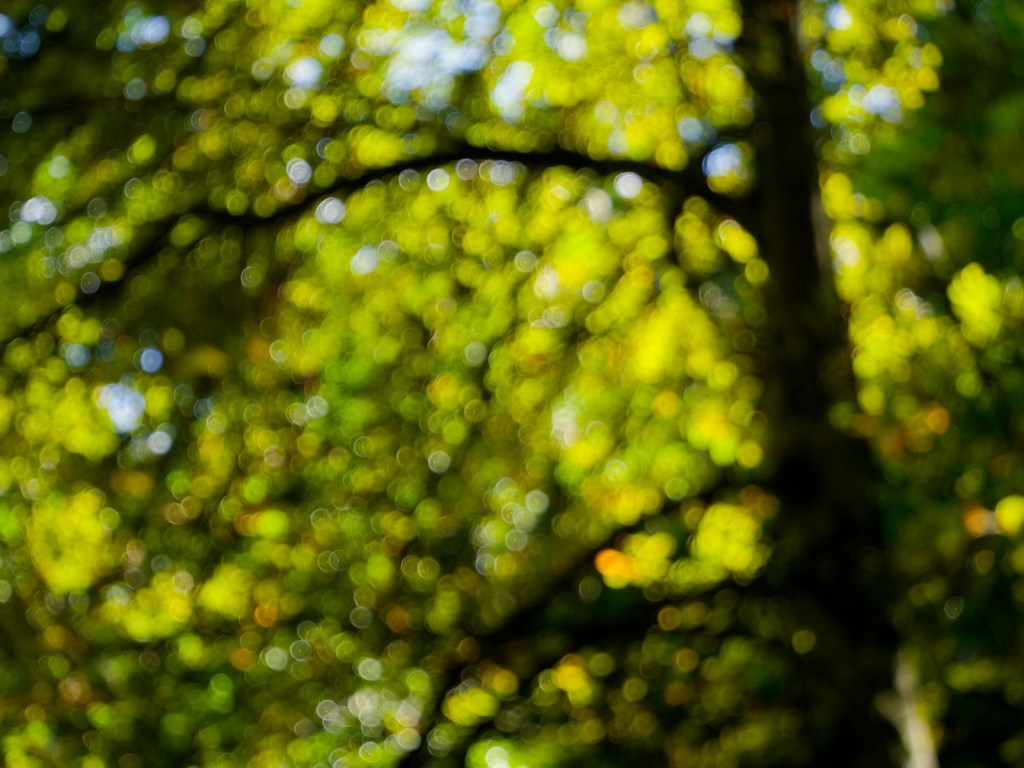
  • Have you ever experienced that moment when you look through the viewfinder to see a beautiful impressionistic image of colours and shapes – only for it all to snap into focus and lose the magic?

    An abstract, impressionistic photograph featuring blurred green foliage and bokeh effects, capturing vibrant colors and soft shapes.
    The image I saw in my viewfinder for a spilt second before the camera attempted to correct everything.

    When I found it happening to me once too often, I started thinking about what had actually happened. Usually the focus was off – sometimes wildly – and I was seeing some magnificent bokeh balls before the focus snapped to the correct position to show me an accurate view of the scene. Often, too, the exposure was off, showing me an underexposed image that made the colours more vivid, more vibrant, before the camera’s auto-exposure kicked in, giving me an accurate exposure.

    It was these realisations that made me decide to take more control. If I defocussed the image, the bokeh balls would return. If I exposed for a low-key image, the colours would pop. The resulting image wasn’t in any sense an accurate view of the scene in front of me. But it did capture the magic that i had seen in the viewfinder for that split second before the camera imposed its world-view.

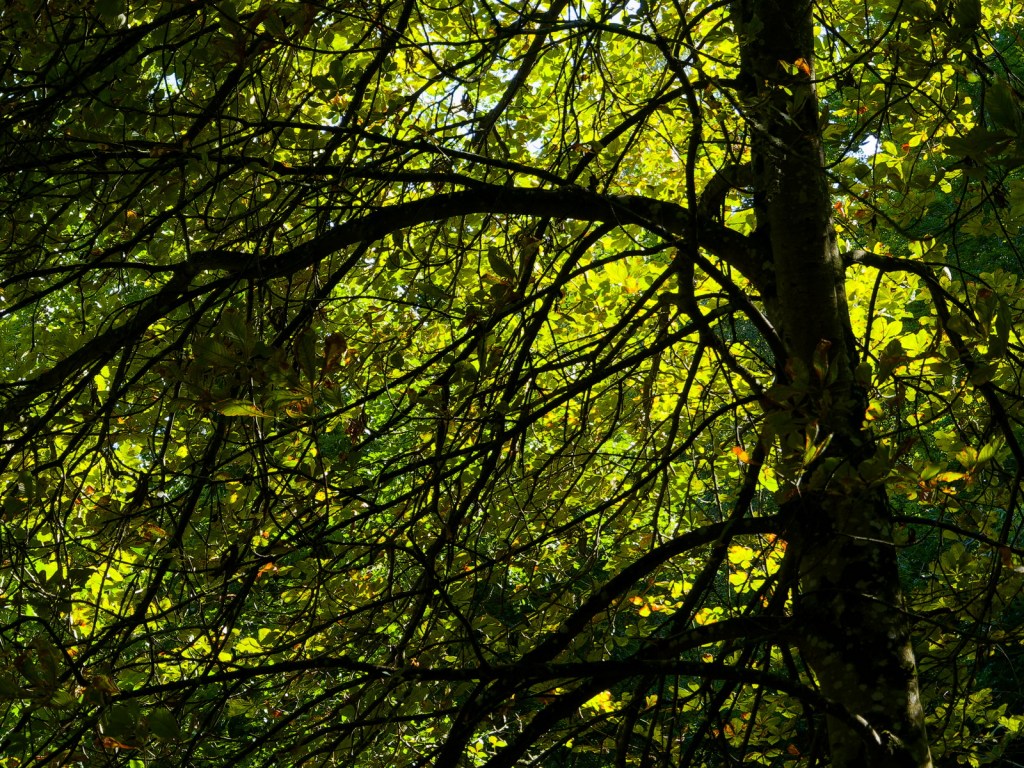
    A view of sunlit tree branches and leaves, showcasing a vibrant interplay of green hues and intricate patterns in the foliage.
    The image my camera wanted me to take. Good enough, but really no more than a snapshot.
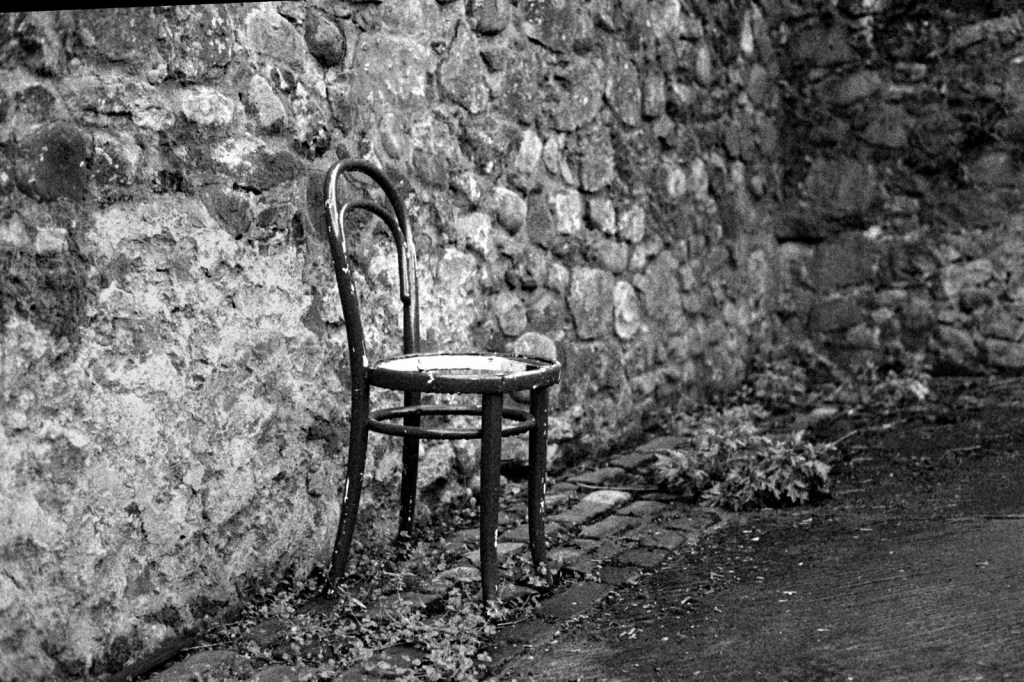
  • I have no clear memory of taking this photo. From my notes, I know that it was taken using Kodak T-Max Pro 400. And from the context – the photos on either side of the negative were all shot in and around Kelso – I presume that that’s the location. But beyond that, my memory fails me.

    A solitary, weathered chair leaning against a stone wall, surrounded by cobblestones and vegetation, evoking a sense of abandonment and the passage of time.

    The subject reflects a lifelong love of derelict and abandoned objects. Trying to find beauty in the mundane and the ugly. There’s an obvious contrast with the stone wall. It’s far older than the chair, and yet much better preserved. Today, if I went looking for the street where the photo was taken, the walls would still look the same. Almost certainly, the cobbles would still have vegetation growing from between them. There may even be an abandoned chair in the same place, but it wouldn’t be this chair, because this chair has long since been consigned to landfill.

    I didn’t stage this scene. I never do. I simply came across an ignored and abandoned object, and tried to find beauty in the ugliness. This is a scene of emptiness – but it’s also a scene which harks back to earlier days, when this chair was a treasured possession. Maybe a bedroom chair from someone’s first home. Maybe a long-forgotten chair from a conservatory which has long since been adapted for use as a laundry room.

    The use of film adds another dimension here. The film was long-since expired. At least 20 years out of date, I had to work hard on my negative scanner to obtain a usable image. Would the image have been as successful if it were a noise-free digital photo? I doubt it. If it was digital, I would have taken it into Affinity Photo and artificially distressed it. But I doubt I could ever have captured the mood of that expired Kodak film.

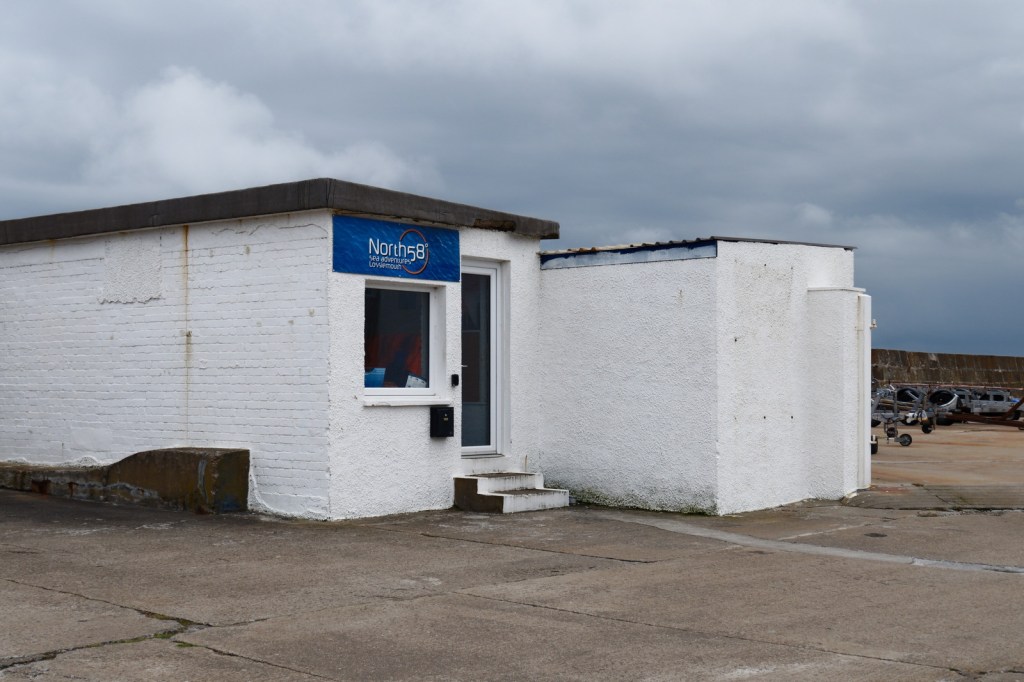
  • According to the internet, liminal spaces are empty or abandoned places that appear eerie and forlorn. as such, I’m often drawn to photograph them. Reddit has a whole community dedicated to liminal spaces but beware – the posts there are often of back rooms or empty shopping malls with no real liminal qualities. Which begs the question – what makes a truly liminal photograph? Consider this image of a building in Lossiemouth Harbour.

    A small, white building with a blue sign reading 'North58' in Lossiemouth Harbour, against a cloudy sky.
    Whitewashed building, Lossiemouth Harbour, under a grey and threatening sky
    • It’s situated in a transitional space. It’s not a place to linger. It’s somewhere that people pass through on their way to somewhere else.
    • There’s a sense of stillness. No people, no clutter. The image has an eerie feel.
    • There’s an ambiguity to the space. Yes, the building is still used and occupied as a commercial unit, but it feels abandoned.
    • The lighting is flat. No shadows, no bright sunlight, a muted grey sky.
    • The colours are muted. Even the door colour, and the sign above the window, fade into the scene.
    • In general, there’s an uncanny normality to the scene, there’s nothing wrong with it, and yet it feels somehow “off”.

    Liminal photography is supremely difficult to do well. Reddit’s liminal community is full of boring photos which prove that. But occasionally, just occasionally, an empty space achieves that sense of unreality which elevates it into something more.

  • If at first you don’t succeed, failure may be your style. It’s no good running a pig farm badly for 30 years while saying, ‘really, I was meant to be a ballet dancer.’ By then, pigs will be your style.

    There are many variations of this quote from Quentin Crisp. They’re all slightly different, and they all share the same underlying truth. There’s no point spending your life wishing for what you can’t have. Just make the most of what you have. So it is with life. So it is with photography.

    I would love to live in the Scottish Highlands. Birds, seascapes, moody mountain views. But I don’t. I live in an urban village on the outskirts of Edinburgh. I have a beach (how many people would want that withing walking distance!) I have some small parks, and I have Edinburgh City Centre just a 25 minute bus ride from my front door. And so, mostly, I shoot street photography. It may not be my first choice, but it’s accessible, it’s enjoyable, and – very important – you don’t need expensive equipment.

    A scenic beach at sunset with a rainbow in the sky, featuring people walking alongside the groyne and enjoying the tranquil sea.
    Rainbow over the Firth of Forth. Viewpoint from the tables outside the Espy Bar, overlooking Portobello Beach

    This photo pretty much exemplifies this approach to photography. I’m not really much into pretty sunset photos. I’m definitely not someone to chase rainbows. But when I’m sitting with a friend, drinking a pint of lager, and that classic rainbow shot falls into view – well, it would be rude not to. It’s even quite stylish, as Quentin Crisp might say.

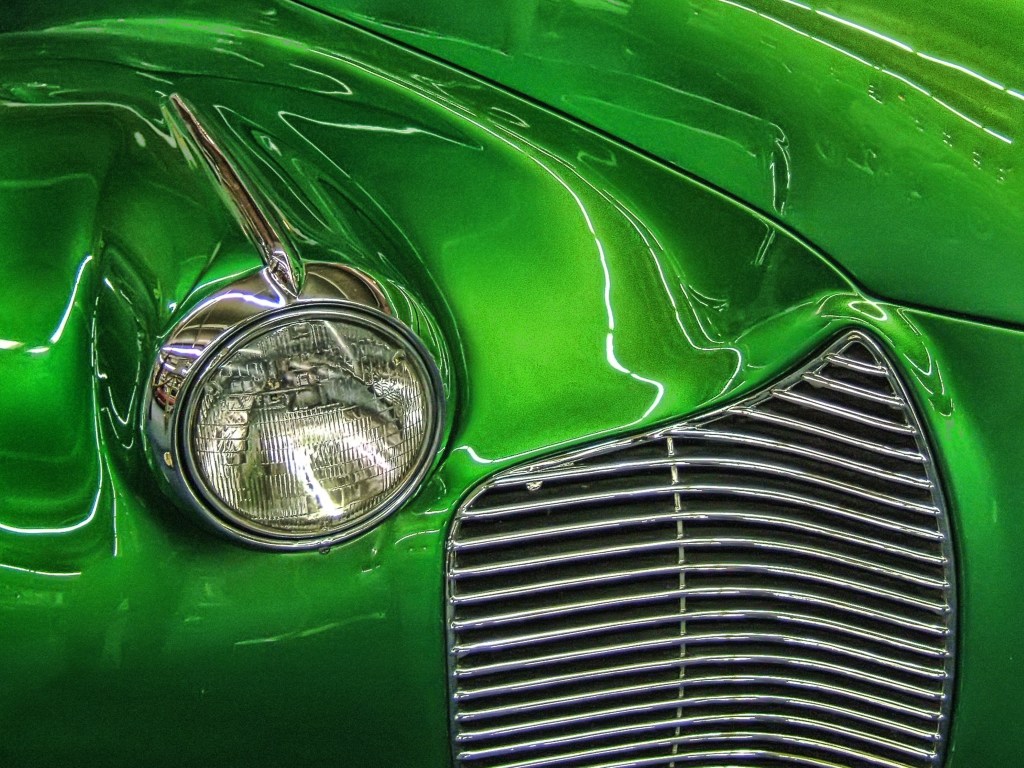
  • Close-up of a vintage car's green body with a round headlight and a chrome grille.
    A close-up view of a beautiful green hot rod in the Imperial Palace Car Museum, Las Vegas

    It was my very first camera that persuaded me that megapixels aren’t important. The Fujifilm Finepix E550 offered an option to shoot at 800 ISO – at the cost of its image output dropping from 6.3 to 3 megapixels. Not ideal, but in 2004, 800 ISO was a rarity in consumer cameras, so I felt the trade-off was fair.

    Visiting the Imperial Car Museum in Las Vegas, I was drawn to this car not just for its shape, but for how it stood so confidently on the showroom floor. The deep green paint, the way the curves caught the light, the quiet confidence of the grille. The whole car just seemed to glow.

    This photograph is about admiration. The craftsmanship, the care, the attention to detail that went into objects built to last. It’s also about time: how things age, and are reinvented over time.

    The hot rod underwent one final reinvention under my camera. I was just discovering digital photography, naively playing around with JASC Paint Shop Pro to edit my photos. Many of my edits were questionable – pushing saturation to unrealistic levels, for example. But this works. My notes tell me that I used the LucisArt plugin on this image. If so, I’ve long since forgotten what LucisArt did, or how I used it. But what I do know is that 3 megapixels was ample to achieve my creative vision, because I’ve printed this photo at 16×12 inches for exhibition use.

    Even today, with phones shooting 50 megapixels plus, my main camera is only 16 megapixels. Size doesn’t matter. .

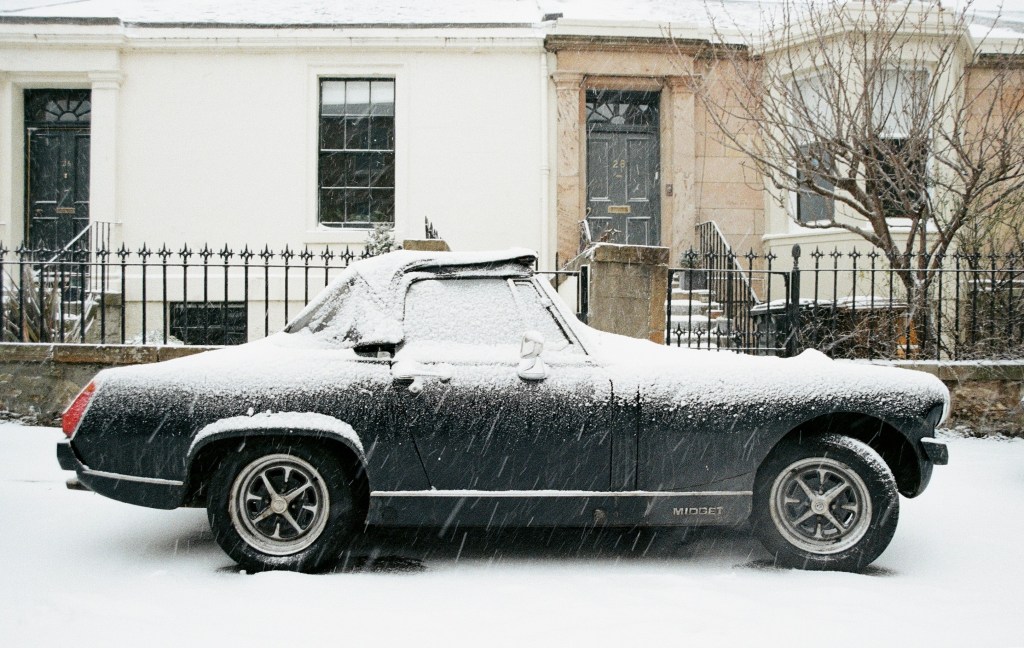
  • A vintage car covered in snow parked in front of a residential building on a snowy day.

    An MG Midget parked on a residential Edinburgh street during the Beast From the East in 2018

    I had often seen and admired this car while out walking in Portobello. Some people like their vintage cars immaculate – concourse ready, as the phrase goes. I go more for the “gently distressed” look, so this car immediately appealed. The ill-fitting hood was far from water-tight, and leaked any time it rained. The Rostyle wheels – an expensive factory-fitted option – looked delightfully out of place on this classic British sports car. And the black polyurethane bumpers – a standard fitting from 1974 onwards – were nowhere near as attractive as the chrome bumpers of earlier models.

    I often meant to photograph it but never got round to it. It would just have been a snapshot. A quick grab-shot of an attractive old car, shoehorned into an undersized parking space. Until the Beast From the East happened. This was a fearsome storm that struck the UK in February 2018, closing down shops, offices, and public transport with its heavy snowfall.

    This much snow is rare in my part of Scotland, so I wrapped up warmly and grabbed my current favourite camera – a Minolta Dynax 4 with 24-50mm f4.0 lens. I loaded it with the only film I had available at the time, which was the budget Kodak Color Plus, and I headed for the beach.

    And finally, I struck lucky with the MG Midget. For once, it was parked with space to spare all around it. The virgin snow revealed no tyre tracks. The slightly-askew hood was letting the snow into the cabin. And the Rostyle wheels revealed a glimpse of the black tarmac beneath. For me, this was an important part of the story. This was no Scandinavian scene, where the snow had built up over months. This was south-central Scotland, where heavy snowfall is a rarity and convertible cars don’t need to be garaged over winter.

    The Color Plus film suits this image perfectly. The soft colours and lazy grain accentuate the vintage feel, and the falling snow softens the whole image. I wonder whatever happened to that car?

  • Once a week, I meet up with a group of friends who share my passion for photography. We alternate between heading out with our cameras to explore and capture new shots, and staying in to share and discuss the photos we took the previous week. It’s a perfect blend of creativity, learning, and good conversation.

    If you know anything about British weather you’ll know it rains a lot. And yet – I’m not sure how – we rarely seem to be rained off. I can only recall a single occasion in the past two years when we’ve abandoned our cameras and sought the shelter of a nearby coffee shop. For a while this morning, it felt like we might have a second outing rained off. For the first half-hour or so, a group of us huddled under the shelter of a tree. But then the rain stopped, the sun came out, and we enjoyed the water droplets glistening on the foliage, and the treacherous but beautiful rain-soaked cobbled roads.

    A view of modern buildings with balconies under a dramatic sky filled with dark clouds.
    Apartment building, Lochrin Basin, Edinburgh

    Inevitably I found myself drawn to the nearest water, the canal basin at Fountainbridge, where I was rewarded with some of Scotland’s most beautiful light. Bright sunshine and storm clouds.

    The theme we had agreed for today was balconies and stairs. Well, those are some pretty spectacular balconies.

    This was the last of the threatening skies. The rest of the day was bright and sunny. We all meandered to Loudon’s and enjoyed each other’s company over a coffee – or maybe a tea – and a gently-warmed scone.